


The Ultimate Guide To SEO With Large Language Models (LLMs)

The digital landscape is evolving daily; to be reliant, we need to evolve and be updated. One of the revolutions in the domain of experienced SEO company is Large Language Models which drive the search engines. Understanding what a large language model is provides clear insights about a new look at SEO strategies, But there is no need to worry as we may explore a new perspective and the LLM SEO guide is the pathway to success.

Going ahead with LLM SEO guide- The New Frontiers of Growth
Large Language models can be compared to GPT4 outlines how search engines understand and process queries. You may try Microsoft Bing to see the difference in action. Once you run a search on Google and Microsoft Bing the results tend to vary considerably.
The first one is a similar set of answers which you may access to find an answer and the other turns out to be an articulate answer which points to a few select sources. What this means is that unless you are one of the few sites quoted by Bing no one will know that you existed.
Normally the search engines relied heavily on keyword matching. However, insights about what is large language model (LLM) is an advanced understanding of natural language, context and semantics that takes the search to a new level. The objective is to grasp the intent of the users ensuring that SEO is less about keyword stuffing and more in terms of valuable and meaningful content.
LLM SEO vs Traditional SEO
The difference between traditional SEO vs LLM SEO lies in how content is discovered and used. Traditional SEO focuses on ranking web pages on search engines using keywords, backlinks, and technical optimization to drive traffic.
LLM SEO, on the other hand, focuses on making content easy for AI systems to understand, summarize, and cite in their responses. Instead of just ranking, the goal is to appear in AI-generated answers.
While traditional SEO targets search engine crawlers, LLM SEO targets AI interpretation and context. Both rely on quality content, but LLM SEO gives more importance to clarity, structure, and real value.
Here’s a quick comparison between traditional SEO and LLM SEO
| Aspect | Traditional SEO | LLM SEO |
|---|---|---|
| Primary Goal | Rank higher on search engines | Get cited in AI-generated answers |
| Focus | Keywords and backlinks | Context, clarity, and meaning |
| Search Platforms | Google, Bing | ChatGPT, Gemini, Perplexity |
| Success Metrics | Traffic, rankings, CTR | Citations, mentions, visibility |
| Content Style | Keyword-optimized | Conversational and natural language |
| Content Structure | Optimized for crawlers | Optimized for AI understanding |
| Keywords | Exact match and density | Semantic and intent-based |
| Authority Signals | Backlinks | Brand mentions and trust |
| User Behavior | Clicks to website | Answers within AI platforms |
| Content Preference | Optimized pages | Clear, structured, answer-focused content |
| Freshness | Important | Very important (frequent updates) |
| End Result | Website traffic | AI visibility and brand exposure |
So how you plan out an LLM SEO strategy is important
LLM SEO guide: Moving over from Keywords to Context
Optimization of semantic search
The role of LLM is to understand content, and optimize it for semantic search is important. It is not only about focussing on keywords; the aim is to understand the broad topics and themes that the audience is invested in. The need of the hour is to incorporate contextually relevant content. Such an approach enhances the ability of LLM to comprehend the objective behind search queries and it is not only about the keywords used.
An example is if the primary keyword is apple you need to ensure that content includes related keywords like fruit, health benefits and recipes.
Using long-tail keywords and natural language
LLM adopts a conversational and natural language. Hence you should create content that reflects on how people speak and interact in real life. These are keywords in the form of questions or statements which is a fair reflection on how users interact with voice assistants and provide more context to the LLMs.
An example is rather than relying on a single keyword like coffee beans, a long tail keyword like buying organic coffee beans online may be a better keyword
Creation of quality content
In the realm of LLM and SEO content is the king. You need to provide compelling and creative content that engages with your audience. This leads to the emergence of conceptually relevant keywords or phrases which the LLMS may latch onto.
Rather than creating content of 500 words, you may incorporate a 2000-word topic on the same topic. This means everything on the topic is covered.
Structure the data and use Schema Mark up
To help LLMS understand the meaning of your content, include Schema and structure data for your website. These are elements that provide you with explicit clues about the meaning of a page
An example is if you are writing a recipe, you may use the Schema of including ingredients that cover the cooking time and other aspects.
Focus on E.A.T principles
These are principles that are not recognised by Google but it is critical when it comes to a LLM SEO guide. You need to provide insights about valuable, high-quality researched content that indicates the website is a reliable hub of information.
Time and time again it has been mentioned that adopting LLM-powered search is all about embracing context and natural language. This goes on to include every article that you may be reading.
The focus is opportunities for voice search
LLMs are designed to understand the conceptual, conversational language they are especially adept at handling voice searches. With the emergence of digital assistants like Google Assistant, Sira voice search has gone on to set up new benchmarks.
What is large language model (LLM) clearly indicating that people tend to ask questions that they normally pose to their digital assistants?
Adapting to user content
In the era of digital-powered search engines, understanding the intent is crucial. Such advanced models can be comprehended. it is not about what the users are saying but it is all about what they mean.
It is fair to say that what is large language model (LLM) focuses on producing content. An example is if someone is searching for the best smartphone 2023, they are looking at reviews and comparisons but not a set of new releases.
How LLMs Work in Search (RAG Explained)
To understand how LLM works in search, you need to look at a concept called RAG (Retrieval-Augmented Generation). In simple terms, LLMs don’t just rely on old training data; they also fetch fresh information when needed.
When you ask ChatGPT a question, it first tries to understand your query using patterns it learned during training. Then, through retrieval, it may pull relevant information from live or indexed sources to improve the answer.


Behind the scenes, content is broken into embeddings, a small numerical representation. These are stored as vectors, which help the model find similar meanings, not just exact keywords.
This is why LLM search optimization focuses more on clarity and context. Well-structured content, clear headings, and updated information make it easier for LLMs to read and reuse.
In short, LLMs don’t just scan content, but they interpret meaning, compare context, and select what best answers the user.
Advanced LLM SEO Strategies
Once you understand the basics, improving LLM search optimization requires a more structured approach. LLMs don’t just look at your website; they look at how your content exists across the web.
One important strategy is entity-based optimization. Instead of only targeting keywords, focus on building your brand as a recognized entity in your niche. This means consistent mentions across trusted platforms.
Next, create topic clusters. Cover related topics in depth so your content becomes more reliable and easier for AI to understand.
You should also focus on brand mentions and user-generated content (UGC). Platforms like Reddit, GitHub, and forums help build real-world trust signals.
Finally, make your content easily accessible. Use clean HTML, avoid heavy scripts, and ensure your pages are easy to read.
In simple terms, strong visibility in LLMs comes from authority, consistency, and clarity, not just keywords.
How to Rank in LLMs (Step-by-Step Guide)
If you’re wondering how to rank in LLMs, the focus shifts from just rankings to making content easy for AI to understand and reuse.
Here’s a simple framework for LLM search optimization:
- Make content crawlable: Use clean HTML and avoid heavy JavaScript so AI systems can access your content easily.
- Add structured data: Use schema (like FAQ or HowTo) to help models understand your content better.
- Use question-based content: Write in a natural way and answer real user queries clearly.
- Build topical depth: Cover related topics and create clusters to improve content reliability.
- Earn brand mentions: Get referenced on trusted websites to increase authority and trust.
- Keep content updated: Regularly refresh your content so it stays relevant and accurate.
In simple terms, clear structure, useful answers, and trust signals help improve visibility in AI-driven search.
Real Examples & Case Studies
To understand how LLM SEO works in practice, let’s look at a simple example.
When you ask ChatGPT something like “best marketing tools for small businesses”, it often pulls answers from trusted sources. Platforms like Monday and Salesforce are frequently mentioned because their content is well-structured, detailed, and easy to understand.
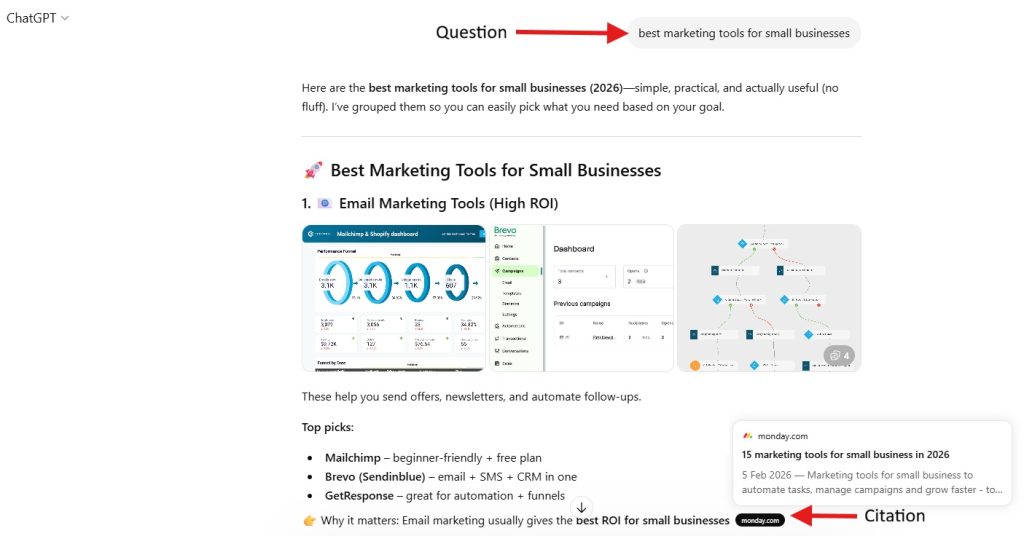
As shown in the example above, LLMs don’t just list links; they generate answers by combining information and highlighting brand mentions. This means your content doesn’t need to rank #1 to get visibility, but it does need to be clear and reliable.
AI-driven search is growing quickly, with more users getting direct answers instead of clicking links. Platforms like ChatGPT are becoming a key part of how people find information today.
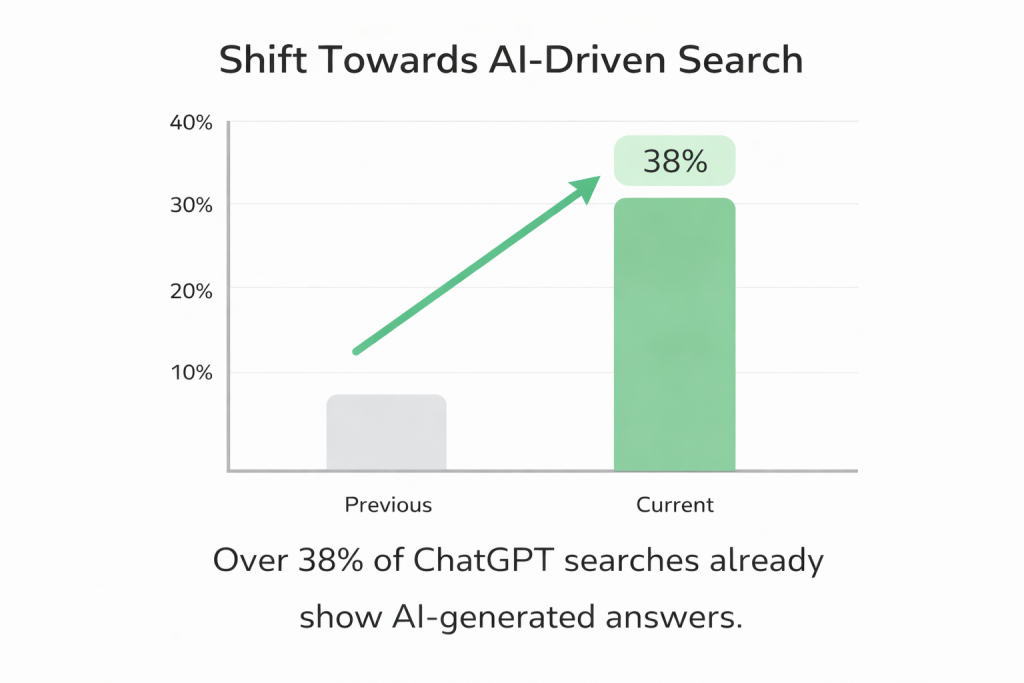
This shows that content that is structured, informative, and trustworthy has a higher chance of being picked by LLMs. In simple terms, the better your content explains a topic, the more likely it is to be cited.
Frequently Asked Questions (FAQs): LLM and SEO
How to rank in ChatGPT?
To rank in ChatGPT, focus on creating clear, well-structured, and trustworthy content. Use simple language, answer questions directly, and organize content with headings and lists. Getting mentioned on trusted websites also increases your chances of being cited in AI responses.
How to rank in AI Overviews?
To rank in AI Overviews, provide concise and accurate answers to common queries. Use structured formats like FAQs, keep content updated, and cover topics in depth. Strong SEO fundamentals and clear content improve your chances of being featured.
Does LLM SEO replace traditional SEO?
No, LLM SEO does not replace traditional SEO. It builds on it. You still need strong SEO basics like quality content and technical optimization, but you also need to make content easy for AI to understand and reuse.
How to measure LLM SEO?
LLM SEO can be measured through AI mentions, citations, and share of voice. Track how often your brand appears in AI-generated answers, how frequently your content is referenced, and your visibility across AI platforms.
What is LLM in SEO? And how to optimize a website for LLMs?
LLM in SEO refers to using Large Language Models (LLMs) like ChatGPT in search and content understanding. To optimize for LLMs, focus on clear, natural language, and answer-based content. SEO LLM strategies include using structured data, FAQs, and context-rich content to improve visibility and relevance in AI-driven searches.
Optimising content for LLMs helps websites become more AI-friendly and appear in better search results.
What is LLM Optimization? And LLM in Search?
LLM optimization means fine-tuning your content and website so it’s easy for AI models to understand. In search, LLMs are used to deliver smarter answers and improve rankings. LLM SEO optimization ensures your site is readable by these advanced models, improving your reach through LLM search optimization techniques.
What is the difference between GPT and LLM?
GPT is a type of LLM (Large Language Model), developed by OpenAI. All GPTs are LLMs, but not all LLMs are GPTs. GPT focuses on language generation, while other LLMs may focus on classification, summarization, or other tasks.
Knowing this helps you plan seo llm content strategies better.
What is LLM Engine Optimization?
LLM engine optimization means improving how your site content is processed and ranked by AI-driven search engines. LLM optimization SEO practices include clean formatting, conversational content, and semantic keywords, helping your content perform better in AI-based ranking systems.
How to write content for LLMs?
To write for LLMs, keep content clear, question-based, and rich with context. Use headings, bullet points, and natural language. Optimising content for LLMs makes it easier for search engines to find and understand your site. This is a key part of llm seo optimization.
How to improve accuracy of LLMs?
Accuracy improves with clean data, updated content, and clear intent. When creating content, avoid fluff, stay on topic, and provide examples. This supports seo llm by helping models deliver more accurate answers.
What are some LLM optimization techniques?
LLM optimization techniques include:
-
- Using structured FAQs
-
- Writing in natural, simple language
-
- Adding semantic keywords
-
- Including schema markup
These help with llm seo optimization and improve performance in AI-driven searches.
What is a SEO LLM course?
An SEO LLM course teaches how to prepare your content for AI models. It includes lessons on seo llm, natural language use, keyword strategy, and llm search optimization. This helps marketers adapt to AI-powered search engines.
What is the difference between SEO LLM and LLM?
SEO LLM focuses on optimizing for search using AI models. LLM refers to the models themselves. So, seo llm vs llm is like comparing the tool (LLM) to the strategy (SEO for LLMs). Both work together to improve modern search visibility.
What are some LLM search optimization examples?
Examples of llm search optimization:
-
- Using questions and answers
-
- Writing how people speak
-
- Optimizing for featured snippets
-
- Creating FAQ-rich pages
-
- These support seo llm and make your content easy for LLMs to process.

Related Post
Publications, Insights & News from GTECH